


Hardwood Spades - Card Game
Silver Creek Entertainment
Hardwood Spades is the kind of card game I open when I want a focused match rather than a noisy collection of casino-style distractions. It is a multiplayer spades game from Silver Creek Entertainment, and its appeal becomes clear quickly: the table, the cards, the bids, and the decisions stay at the center. I do not have to work through a parade of unrelated modes before I can play a hand.
That narrow purpose is also the game’s identity. It is free to start, carries a Teen content rating, and has built a sizeable audience, with more than half a million installs and an average rating of 4.5 from roughly nine thousand ratings. Those figures suggest a healthy player base, but they do not tell the whole story. What matters in daily use is whether the presentation helps me read the table, whether the pace respects the rhythm of a real spades game, and whether the multiplayer focus feels like a strength rather than a limitation.
How Hardwood Spades turns a card table into a playable mood
The first impression is deliberately about the table
My first impression was that Hardwood Spades understands restraint. The presentation points my attention toward the felt, the hand in front of me, and the changing situation created by each bid and trick. That sounds simple, but card games often bury their core activity under menus, rewards, decorative effects, or casino imagery. Here, the table itself supplies most of the visual language.
That choice gives the game a more settled personality than many casual card alternatives. I can imagine using it during a short break, on a quiet evening, or while waiting for a friend to become available for a match. The experience does not need a complicated fictional premise to justify itself. Its setting is the card table, and the game is strongest when it trusts that setting.
The visual direction also supports a useful practical habit: I can concentrate on the order of play instead of constantly interpreting what the screen is trying to sell me. In spades, a small lapse matters. Forgetting which suits have been played, misreading the bid, or overlooking the likely distribution of high cards can change a hand. A calmer interface gives those decisions room to breathe.
Related News

Threads in Real Life: Who Should Join, Lurk, or Leave

How SHEIN Turned Shopping Into an Endless Content Feed

How to Make Fortnite Feel Smarter on Mobile

Should You Switch to Microsoft Outlook on Mobile?

Why Gallery Keeps Pulling Users Back

X Review: Why Its Network Still Matters
There is a trade-off, though. Anyone looking for a highly animated card battler, a story campaign, or a broad collection of themed activities may find the presentation too focused. Hardwood Spades is not trying to turn a traditional trick-taking game into an action spectacle. Its atmosphere comes from concentration and repetition, so the people who enjoy it most will probably be those who already like the underlying game.
A visual language built around clarity rather than spectacle
The art direction works because it makes the table feel like a place for decisions. Card faces need to remain readable, bids need to be easy to follow, and the active state of a hand should not be confused with decoration. In my experience, that kind of visual discipline is more valuable in a multiplayer card game than elaborate backgrounds would be.
I also like the way a traditional table setting creates a small sense of occasion. Even when I am playing on a phone, the layout encourages me to treat a hand as a complete unit: assess the cards, make a bid, watch the tricks develop, and then review whether my plan held together. That structure gives the match a beginning, middle, and end without needing a campaign or a narrative voice.
Gallery
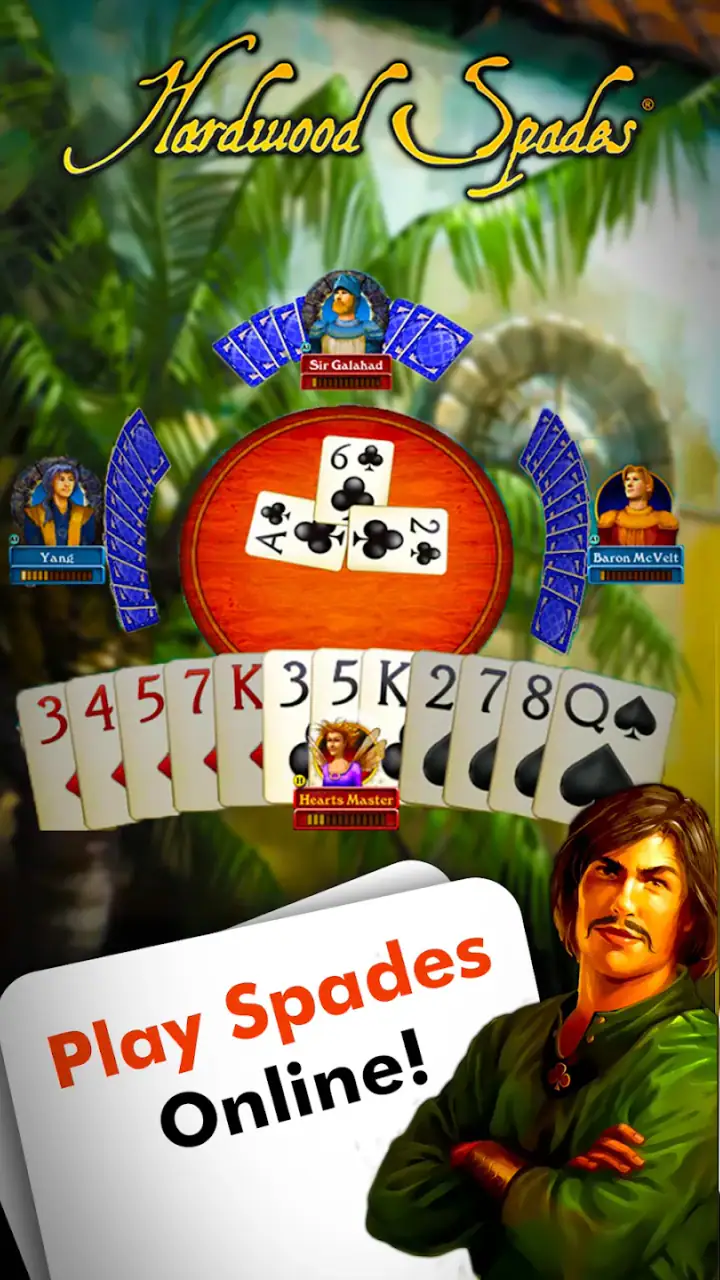
One useful tip is to play with the same attention I would bring to a physical table rather than rushing through familiar actions. The comfortable look can make the game seem casual, but the decisions are not automatically casual. I get better results when I pause before bidding, count likely winners, and remember that a successful hand depends on partnership as much as on the strength of my own cards.
The setting also makes the game easier to recommend to someone who wants a straightforward digital version of spades. I would not recommend it as a general-purpose card-game sampler, because its identity is quite specific. I would recommend it to a friend who already knows the rules or is willing to learn them and wants the digital table to stay out of the way.
Sound and rhythm give each hand its shape
Sound is not the main attraction here, and that is appropriate. In a game built around reading cards and anticipating opponents, audio should support the rhythm rather than compete with it. The experience works best when the audible feedback marks actions without making every play feel like a reward event.
That restrained approach helps create a coherent mood. A hand has a natural tempo: bidding is thoughtful, early tricks establish information, the middle of the hand reveals whether plans are working, and the final tricks often become a calculation of risk. The game’s atmosphere fits that progression better than a hyperactive presentation would.
I found this especially useful in everyday play. If I have only a few minutes, I can judge the session by the hand rather than by a long chain of unrelated tasks. If I have more time, the same structure can settle into a longer run of matches. The pacing is therefore flexible without needing a separate quick-play identity.
There is a limitation for players who expect strong audio personality. This is not the sort of game I would choose for a rich soundtrack, dramatic narration, or a constantly changing soundscape. Its mood is closer to a quiet game room than to a theatrical production. That can feel understated, but it also means the game is less tiring during repeated sessions.
My practical advice is to treat the sound as part of the table rather than as entertainment on its own. If I want to focus, I can let the visual flow carry most of the match. If I am playing casually, the small cues help me stay aware of turns without forcing me to stare at the screen every second. That balance suits a game where attention should remain on the cards.
Why the multiplayer focus fits the mechanics
The central mechanical fit is strong because spades depends on information shared through play. A bid communicates confidence, a discarded card reveals something about a hand, and the choice to spend or protect a high card affects the partnership. Multiplayer is not an extra layer placed on top of the rules; it is where the rules become interesting.
That also explains why the game can feel more demanding than its familiar appearance suggests. The basic actions are easy to understand, but good play requires memory and restraint. I have to think beyond the trick in front of me. Winning a trick can be useful, but taking too many tricks may create a different problem if the bid was conservative. Likewise, a weak-looking card can become important when I am trying to control the lead later.
A concrete workflow helps. Before bidding, I look for likely spade control, count dependable winners, and consider whether my hand can support the number I am declaring. During the hand, I track which suits opponents appear to be short in and whether my partner’s plays confirm or challenge my first reading. Near the end, I stop thinking only about individual tricks and start thinking about the score situation and the safest route to the contract.
This is one of the game’s less obvious strengths: it rewards a player who develops a repeatable thinking process. I do not need flashy reflexes. I need to slow down at the right moments. That makes it approachable for people who enjoy strategy but do not want a real-time card game, and it gives experienced spades players enough room to keep refining their choices.
It is also where the multiplayer nature can expose friction. A thoughtful hand depends on everyone respecting the pace of play. If another player acts too quickly, disconnects, or treats the match as something to rush through, the atmosphere can suffer even when the rules are working perfectly. This is a general challenge for online card games, but it matters more here because the pleasure comes from shared concentration.
What the free model means during normal use
Hardwood Spades is free to play, with optional in-app purchases ranging from $0.99 to $99.99 per item. I would look at that range carefully before spending anything, especially because the basic appeal of the game is its focused card-table experience rather than a large collection of consumable content.
The sensible approach is to begin with ordinary play and decide whether the core multiplayer loop earns a place on the phone. I would not make a purchase simply because the game is free to install, and I would keep an eye on the payment prompts in the same way I would with any free mobile title. The important question is whether the available experience already matches what I want from a spades app.
For a player who wants a relaxed, traditional card game, the free entry point is useful. It lowers the effort needed to test the table, the pacing, and the multiplayer atmosphere. For someone who dislikes any form of optional spending or prefers a one-time purchase, a paid alternative may feel cleaner. That preference is reasonable, particularly if the goal is a distraction-free game with no purchase decisions at all.
The Teen rating is another practical point for households. I would not treat a card-game label as a guarantee that every player will find the online environment suitable, because multiplayer interaction can vary. Parents should still decide whether the game fits the player and the way the device is used. For adults and older teens who already understand spades, the rating is unlikely to be a barrier, but it is worth noticing before installing.
How it compares with other card-game choices
Compared with casino-themed card apps, Hardwood Spades feels more honest about what it is trying to do. There is no need for me to pretend that I am managing a casino bankroll or chasing a parade of unrelated rewards. The focus stays on bidding, partnership, and trick-taking. That makes it a better choice for a reader who wants a recognizable card game rather than gambling-style presentation.
Compared with a physical deck, the advantage is convenience. I can play without finding three other people, shuffling cards, or keeping track of the table manually. The digital format also makes repeated practice easier. I can use a session to work on bidding discipline or card memory without needing to organize a full room of players.
The physical version still has advantages that an app cannot reproduce. Face-to-face conversation, table manners, and the social tension of watching a partner react are part of the traditional experience. If those human details are the main reason I enjoy spades, this game will be a supplement rather than a replacement.
Compared with broad card-game collections, the specialization is both its advantage and its weakness. A collection may offer more variety when I want to move from solitaire to hearts to another game. Hardwood Spades is better when I already know what I want to play and do not want to search through a crowded menu. I would skip it if my priority is variety rather than depth in one ruleset.
Compared with a purely offline spades game, the multiplayer emphasis changes the feeling of practice. Playing against computer-controlled opponents can be convenient when I am traveling or have an unreliable connection, but it does not create the same uncertainty as facing another person. The best reason to choose this title is therefore the shared match experience, not simply the presence of digital cards.
Small decisions that make the game more enjoyable
I get more from each session when I separate learning from winning. After a difficult hand, I try to identify whether the mistake happened during the bid, the opening lead, or the decision to take a later trick. That simple review is more useful than judging the whole match by the final result. Spades often punishes one overconfident choice several tricks after it was made.
Another helpful habit is to avoid treating every strong card as an immediate opportunity. A high card can be valuable because it wins now, but it can also be valuable because it controls when a suit is led. Holding back can protect a later plan, especially when I am trying to help my partner rather than collect tricks for myself.
I also recommend paying attention to the rhythm of the table. If the match is moving quickly, I prepare my next decision while the current trick is resolving, but I still pause before committing to a bid. If the pace is slower, I use the extra time to reconstruct which suits have disappeared. That adjustment keeps the game from feeling either frantic or unnecessarily drawn out.
For new players, I would learn the basic rules away from the pressure of a serious multiplayer hand, then enter matches with a modest goal: make bids that the cards can support and observe how the partnership develops. Trying to make spectacular plays immediately is less useful than learning how a safe contract is built. Once that foundation is comfortable, the deeper decisions become much easier to appreciate.
For experienced players, the more interesting challenge is consistency. The game’s traditional presentation does not distract from the question of whether my bidding is disciplined across many hands. I can use it as a compact practice space for reading distributions, managing risk, and recognizing when a seemingly attractive trick is actually harmful to the contract.
Who should install it, and who should pass
I would recommend Hardwood Spades to players who want a dedicated multiplayer spades experience with a composed table atmosphere. It suits people who enjoy decisions that unfold over several tricks, who are comfortable with partnership play, and who prefer a game that leaves room for thought. It is also a sensible choice for someone moving from physical cards to mobile play and wanting the digital version to preserve the identity of the original game.
I would be more cautious about recommending it to someone who wants instant action, a story-driven campaign, or constant visual novelty. The quiet presentation may seem plain if the card table itself is not enough to hold attention. I would also point variety seekers toward a broader card collection, and I would suggest a one-time-purchase alternative to anyone who dislikes optional purchase systems on principle.
The game’s current version is 2.0.635.0, and it supports devices running Android 7.0 or later. That makes checking device compatibility a sensible step before installation, particularly if the phone is older. The title has been available since December 19, 2011, so its identity is rooted in a long-running style of digital card play rather than a newly invented trend.
The atmosphere verdict: focused, traditional, and quietly strategic
After spending time with it, I see Hardwood Spades as a mood piece built from ordinary card-table details: a settled visual setting, a measured pace, and mechanics that reward attention instead of reflex. The art and sound do not try to overpower the rules. They create enough atmosphere to make a hand feel complete while keeping the important information visible.
Its strongest quality is coherence. The multiplayer design, the traditional card setting, and the restrained rhythm all point toward the same experience: sit down, read the situation, make a plan, and see whether the partnership can carry it through. That is more specific and more valuable than a generic promise of casual entertainment.
It is not the right app for every card player. The narrow focus, online dependence of the social experience, and optional purchase model may push some people toward other choices. Yet for me, those limitations are easier to accept because the game knows what it wants to be. I would recommend giving it a try if you want a dedicated spades table rather than a casino-themed distraction, especially when you value thoughtful pacing over spectacle.
Hardwood Spades leaves the best impression when I stop expecting it to behave like a broad mobile game and judge it as a focused card room. In that role, it is approachable, strategically rewarding, and atmospheric in a quiet way. The free starting point makes testing it easy, while the real reason to stay is the satisfying tension between a bid, a partner’s play, and the final trick that decides whether the plan worked.
FAQs for Hardwood Spades - Card Game
What is Hardwood Spades - Card Game?
Hardwood Spades - Card Game is a digital version of the classic trick-taking card game for Android and iOS devices. It lets you play Spades against computer opponents or other players, depending on the available game modes. The app generally focuses on traditional rules, competitive matches, customizable options, and a polished card-table presentation designed for both casual and experienced players.
Can I play Hardwood Spades offline?
The availability of offline play may depend on the version and platform you install, but Hardwood Spades typically includes options for playing against computer-controlled opponents without requiring a constant internet connection. Online multiplayer features, matchmaking, leaderboards, and social functions normally require connectivity. It is worth checking the app’s store listing and permissions before downloading if offline access is especially important to you.
Does the game support online multiplayer?
Hardwood Spades is designed to support competitive card-game sessions, and its online features may allow you to play against friends or other players over the internet. Match availability, private rooms, rankings, and account requirements can vary between releases. Before starting an online match, make sure you have a stable connection, since interruptions may affect the game or cause you to lose progress.
Is Hardwood Spades suitable for beginners?
Yes, the game can be suitable for beginners, particularly if you are familiar with basic trick-taking card games. New players may need time to understand bidding, following suit, managing spades, and coordinating with a partner. Computer matches can provide a useful way to practice before entering online games. However, the difficulty and available tutorials may differ depending on the device version.
Are there in-app purchases or advertisements?
Hardwood Spades may include advertising, optional purchases, or premium features depending on the platform and edition you download. These can potentially relate to removing ads, unlocking additional content, or accessing enhanced customization and online functions. Because pricing and monetization policies can change, review the current Google Play or App Store listing before installing, especially if you prefer a completely free experience.
Pros
- Clear card graphics make suits and ranks easy to recognize.
- Smooth animations keep each trick feeling responsive.
- Helpful hints can assist players who are new to Spades.
- Playable in short sessions
- making it convenient for mobile gaming.
- Low-pressure gameplay suits casual players looking to relax.
Cons
- Some matches may feel repetitive after extended play.
- Difficulty can seem uneven between different opponents.
- Ads may interrupt the experience for non-paying players.
- Limited customization may disappoint players seeking more themes.
- Requires a stable connection for certain online features.


